Never Stop Learning
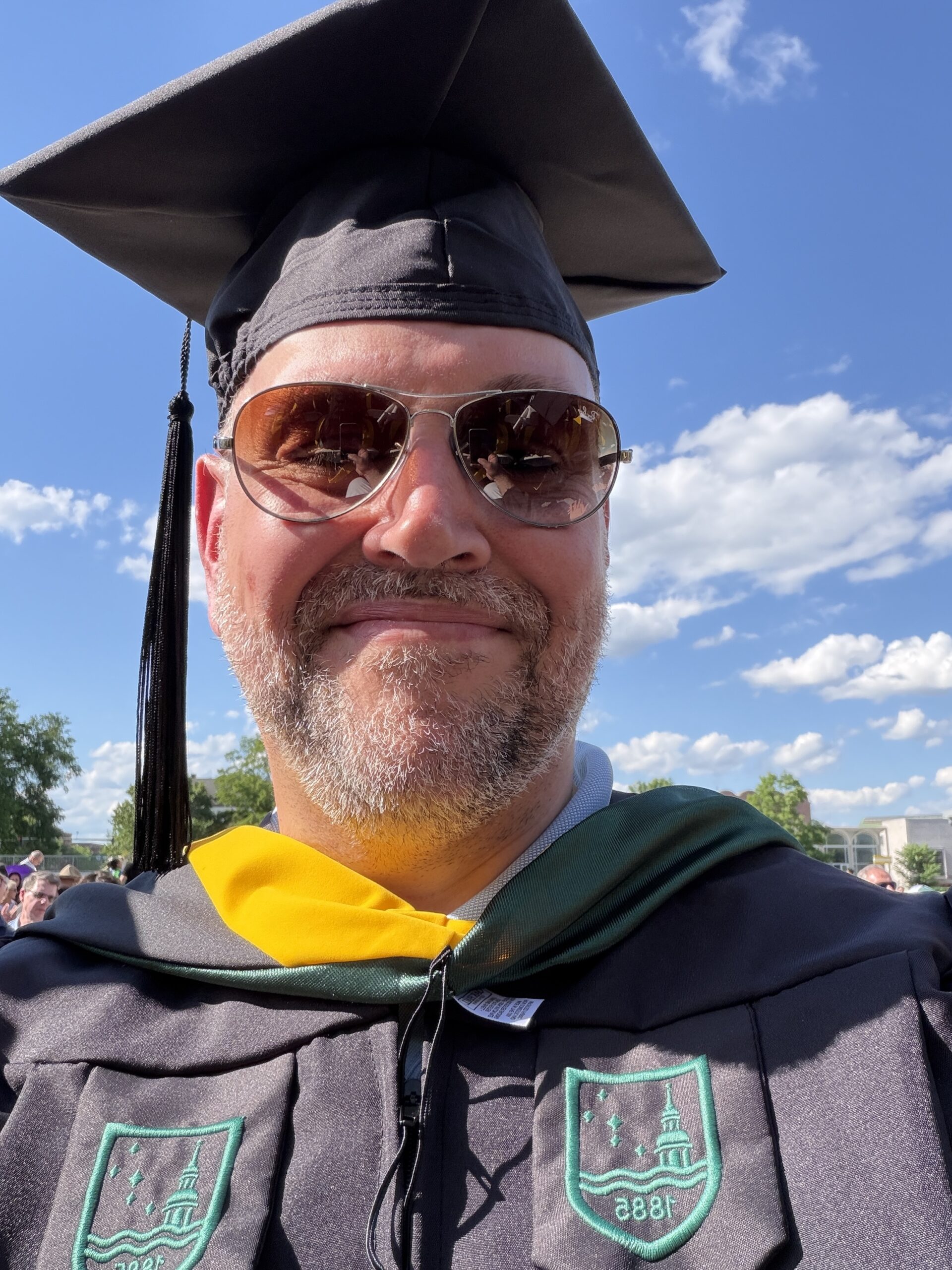
On May 8, 2026 by Jonathan ZdziarskiA couple years back, I wrote about my experience in professional life without a degree, and the challenges it posed. At 50 years old, I recently completed a master’s degree in computer science at Dartmouth College, with a focus including Formal Methods and Artificial Intelligence. The way Dartmouth is organized, I was able to integrate some Electrical Engineering courses into my academic work as well. I’ve waited for half a century to finally earn something, and so for me it’s a meaningful personal accomplishment; having my family proud of me means the world. In retrospect, I’m so fortunate to have waited as long as I did to attend college, as the science we’re studying today is so incredibly cutting-edge.
Education is often squandered on the youth, before students can fully appreciate the problems we’re trying to solve in the world today. There is likewise a deep sense of ethical responsibility required to handle sensitive technology in this day and age, and the burden of showing restraint until an advancement can be ethically contained. The stakes have never been higher for ethics in tech. Powerful knowledge without a deep moral sense of responsibility may be why we’re losing the battle for industry ethics. Most young students naturally prioritize education in hopes of attaining some form of professional achievement and success. That’s admirable, but success typically provides only temporal reward. In my own journey, I’ve felt something deeper and far more valuable; empowerment to make greater contributions to advancement – and to the common good – than professional success alone can. I also pursued formal education for personal reasons: I wanted the opportunities denied in my youth. I was a troubled teenager, who ended up failing out of high school and later got a GED. I had been told I’d be pumping gas my whole life, and the most depressing thing about that is I let myself believe it.
The rigor of the Master’s program was real – and quite welcome. Naturally, I studied material I was truly passionate about and wanted to dive deeper into. This is by far one of the best schools to study Artificial Intelligence (I am interested in formal verification of AI outcomes for safety, as well as other more classical topics). Other things I’ve just never had a chance to get exposed to. Digital circuit design and FPGA programming is incredibly fun. Topics such as Complexity Theory fascinate me as well. Industry’s view of academia is mixed. I ran into several individuals who thought I was wasting my time. They’re not entirely wrong on some level, but miss the big picture. Indeed, many courses certainly make easy work for anyone who’s been in industry long enough (Operating Systems and Reverse Engineering, for example), and some theories seem largely detached from practice (Applied Cryptography, for example). That is, however, where experience really can shine going to school later on in life.
Life experience transforms the equation: working in the trenches gives you an advantage many academics don’t have. The ability to discern tractability, identify nuance, and ground computational challenges in reality are skills honored only at scale. With the experience of industry, I’m able to take every new thing I’ve learned to piles of problems we’re already working hard to solve. Understanding the gap between elegant theory and messy implementation are two halves of a whole that require both worlds to fully appreciate. This past month, I celebrated nine years at Apple which has greatly shaped my understanding of these things at a very large scale; unless you’ve been in an environment where you’re deploying to billions of people, it’s impossible to fully appreciate the challenges that come with it, and why some things are done a certain way. Without this experience, many in academia tend to spin their wheels building magnificent castles in the sand. A key ingredient to critical thought is looking at best practices and seeing where they fall short. Right along side that is the experience one gets in seeing how your work impacts the lives of others. How a simple feature is designed has the power to change (and even sometimes save) lives. Tech is a double-edged sword, though – harm can just as easily be done if we go out into the world pursuing a fortune without showing restraint in the new technology we birth. Such are the things one can only learn from experience.
Yet as for knowledge, however, college is plentiful even for those who have been in industry a long time. The skills I took away have helped to round out my understanding of how I reason about complex computational problems. Engineers tend to build a thing from the ground up without tracing the intellectual lineage that brought us to the current state of the art. Too many talented coders operate at high levels of abstraction without grasping what lies beneath—and that’s both abstraction’s gift and its peril.
Much of industry operates on the principle of, “do it, then talk about it”, while academia favors the inverse. This tension fascinates me. Academia genuinely thinks they’ve invented every good thing in computers, and any and all engineering came from some glorious paper cited more often than it’s been read. Having grown up in a time when we built much of the Internet, such academic beliefs obviously ring as total bullshit; the engineers in the field building the things let experimentation and the love of the work lead them to many similar conclusions. This ironically proves that such solutions are far more obvious than academics typically think they are. To frame this dynamic, I turn to a theologian by the name of Justo Gonzales to help shape my perspective.
Gonzales argues that history has duality – two core driving forces that he calls, “because” (cause and effect), and “so that” (reason, logos, divine purpose). Ask why a billiard ball moves, and a scientist cites the cue ball’s impact – a “because”. Ask the game’s creator, and they’ll say, “so that it sinks in the pocket” – purpose pulling momentum forward. Gonzales saw this in theology and science: divine purpose pulls life forward; scientific catalyst pushes it. Both are essential. The same is true of technology and science: engineering pulls progress forward with purpose – the demand that drives innovation. Academics create momentum – research that pushes us forward. When both align (as they have in artificial intelligence, for example), our advancement accelerates beyond their sum of forces. When AI was first birthed (at Dartmouth, nonetheless), the community split into two groups: the Neats vs. the Scruffies. The Neats focused on the mathematically beautiful theoretical science behind AI, while the Scruffies focused more on engineering solutions that actually worked. Together, they’ve achieved some great advancements that neither likely could have done on their own.
After a lifetime of learning through reading books and doing things, returning to school quickly went from downright terrifying to an intellectual high – a direct line to a deep well of knowledge and reason. What younger students see as “grueling work” feels more like play at this age; learning at this stage makes the rigor the reward, and keeps me feeling young.
Yes, academia has flaws. One must look past all the pomp of tenured professors and their fragile egos. One must be collegiate, while in industry you’d just call bullshit to someone’s face. R1 universities prioritize research over teaching; they can be more interested in having good research rather than making good researchers. What support the environment lacks, however, forged resilience in many of the students I’ve watched – a trait that industry deeply respects.
I plan to continue this late-in-life journey and pursue a Ph.D. Why? In the words of Howard Thurman, “Don’t ask what the world needs. Ask what makes you come alive, and go do it. Because what the world needs is people who have come alive.” Passion, drive, and fortitude not only have the potential to change the world for the better, but are human traits no AI will ever be able to replace.
Provenance still matters. Working with AI doesn’t make one an engineer any more than working at McDonald’s makes one a chef. AI is intellectual fast food: instant, mass produced, highly processed, and often lacking nutritional value. Perhaps we should call AI coding “Fast Foo”. I’m confident in my skills, and confident that they will remain in demand over the long haul. As Steve Wozniak recently said, we have “actual intelligence”. Those laying off en masse to favor AI continue to produce the world’s most mediocre, unmaintainable canned products, while those valuing human ingenuity and domain expertise – perhaps with AI as a tool to build scaffolding – continue to change the world for the better. They’ll be hiring employees back in droves after the first Claude outage. For whatever it’s worth, AI is forcing humans to innovate at accelerated levels – the wisdom of today is merely the scaffolding of tomorrow. AI, for better or worse, has the power to push humans to higher levels of thinking in the same ways the home computer and the Internet did. The calculator never bothered Leibniz.
Pope Leo recently put it well, “I feel entrusted to look upon another huge transformation with eyes of faith, with lucidity of reason, with openness to mystery and with cries of the poor and the earth resounding in my heart.” The world needs those who are a driving force for good; in technology as well. As AI transforms the world, we in tech must be the watchers who ensure it is used to serve humanity, rather than the other way around. But also, there are many areas of technology which we can make great impact in to protect and raise up others. The world needs people who care.
We as humans are built to learn and create. Should we lose the desire to do so, we’ll become the machines. Learning is life, just as music is life, just as doing what defines you is life. In the quest for wisdom, it’s the journey itself that matters.